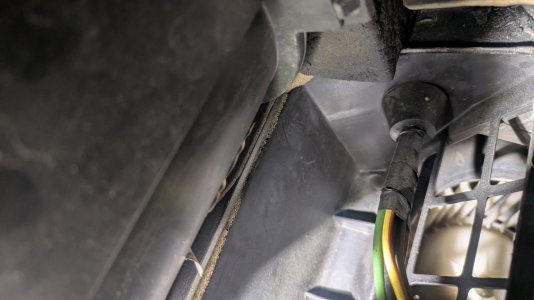
Before you replace the fan motor replace the resistor. It in the engine bay kinda below and to the side of the fan motor. In my 93 I had low with a noise and high. Eventually it quit on low. I thought motor was bad. Replaced it a friend said he thought the switch was bad. After the motor replacement didn’t work I replaced the switch. Still didn’t fix it so I ordered the resistor. Now it works as it should. I researched it after thf the VOLTAGE is lower than 12 volts to the switch, OR to the resistor ALL the speeds will be slowed even if the resister is working.
Looks like the PO really gutted it.
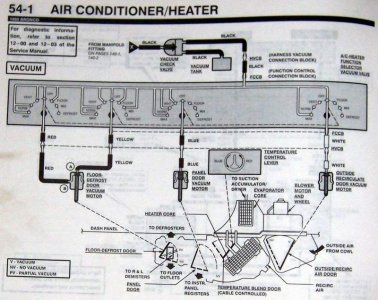
Below is a diagram.
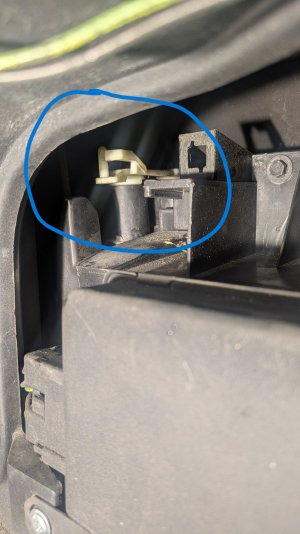
I think there are 3 actuators, two under the dash and one under the hood. if you move that white lever do you get heat or air flow?
Default air flow is to defrost the windshield. So check there for air flow.
the lack of heat could be from the blend door in the wrong position which I would imagine is what you took a picture of, so if you move that lever does the temp change? can you just put a rubber band or zip tie on it for now?
If you are missing the actuators, then are you missing the vacuum lines? Might be worth going to a junk yard and just grabbing everything if you want to restore it to original working condition.
View attachment 32931
Tiha's got the right idea-lotta stuff is probably missing.
If you can take/find photos of a Bronc that's got everything living under the dash for a/c that will help to see where things like wires, hoses and linkages are physically SUPPOSED to be in relation to each other.
IN RE THE HEATER FAN SWITCH AND ITS RESISTOR.
If the voltage checks out ok getting TO the components, check their grounds too.
ALSO, try burnishing the fan switch contacts by moving the speed selector handle through its entire range MANY times back and forth. Its not unusual on old vehicles for mechanical switch contacts to oxidize enough to make poor connections-sometimes enough to completely prevent contact. The positions used LEAST are the ones most likely to NOT work.
(My '86 B2's fan switch was like that when I got it 15 years ago-only 1 speed worked.)
Something else to try,
since you said the airflow has never been strong,
Things that make ya say WHY???

<g>
. THAT sounds like leaves or maybe something that dropped in through a windshield vent-or a loose piece of dried-out foam, or a wire-or some loose electrical tape where it isn't supposed to be. .
Check to see if the heater's
air intake path is obstructed anywhere-starting from the cowl. From what you wrote (about air not flowing fast), it sounds as if there may be something reducing the air flow getting TO the heater core AND its likely that you have have something that either fell in through a dash windshield outlet, or was already inside the air path-like a piece of sealing foam. You could also
have had poorly connected/poorly sealed ductwork, or missing/deteriorated/torn sealing foam that is
supposed to seal ductwork around the heating core (so that all air to be heated goes through it) and to seal the fan in the ductwork.
If your heater core is still not installed, you might try pulling the resistor FIRST and looking into the ductwork for debris from there too. A mirror helps. If you see anything that isn't supposed to be there pull the fan for a better look. If there are a lot of leaves in the ductwork, shop air is probably the easiest way to get them out-if they aren't impacted and wet.
Many of the vehicles back then did not have sufficient screening to prevent leaves/pine needles, twigs, rodents, etc. from getting in through the heater's cowl air intake (or it was removed) and wherever anything has a chance to get snagged, (or built-in, like mouse nests, insect nests) stuff will start to back up. Vehicles that sit outside for long periods of time and those parked near trees are especially vulnerable to leaves. It can be a blockage at a bend in the ductwork, or caught by anything sharp, like a poorly fitting seam in the ductwork.
Or by the heater fan's resister. (On a lot of vehicles from that era the resister sits unprotected INSIDE the ductwork before the heater core.